

It’s 9 a.m. on a Monday. Your calendar is a collage of blue rectangles – a busy day full of meetings and connections. Yet, when you click “Join”, all you see are blank tiles and muted microphones. You’re “at work,” but you feel utterly alone.
Hybrid Work started as a boon to the employee – work from home whenever you want, sleep-in if you wish, or work from the pool-side while sipping on a cocktail.
Soon, however, the harsh reality of being away from work showed up. No more coffee breaks after meetings, no more walks to the canteen, no more awkward stares after a presentation gone wrong. Now mistakes were amplified, bad network was vilified, and patience was lost.
Hybrid work may not have invented loneliness, but it sure removed the micro-interactions that defended a person against it.
The Two-Dimensional Model of Loneliness
There are many ways to understand loneliness. Loneliness can be separated into two distinct types (Weiss):
- Emotional loneliness — not having a trusted person at work you can turn to when it really matters (a manager, mentor, or close colleague).
- Social loneliness — not feeling part of a wider circle: team routines, informal groups, communities of practice.
Weiss’s distinction also explains everyday patterns: someone can be surrounded yet not included (social), or feel known yet not supported (emotional). Collaboration can slow even when calendars are full if the underlying bond is missing.
Recent research adds more nuance:
- Existential loneliness — the feeling that your work lacks meaning or that you don’t quite belong in the bigger story of the organisation.
- Physical loneliness — highlighted during the pandemic: many calls, zero in‑person contact. It’s the absence of simple nearness and touch that screens cannot provide.
The Cost of Loneliness
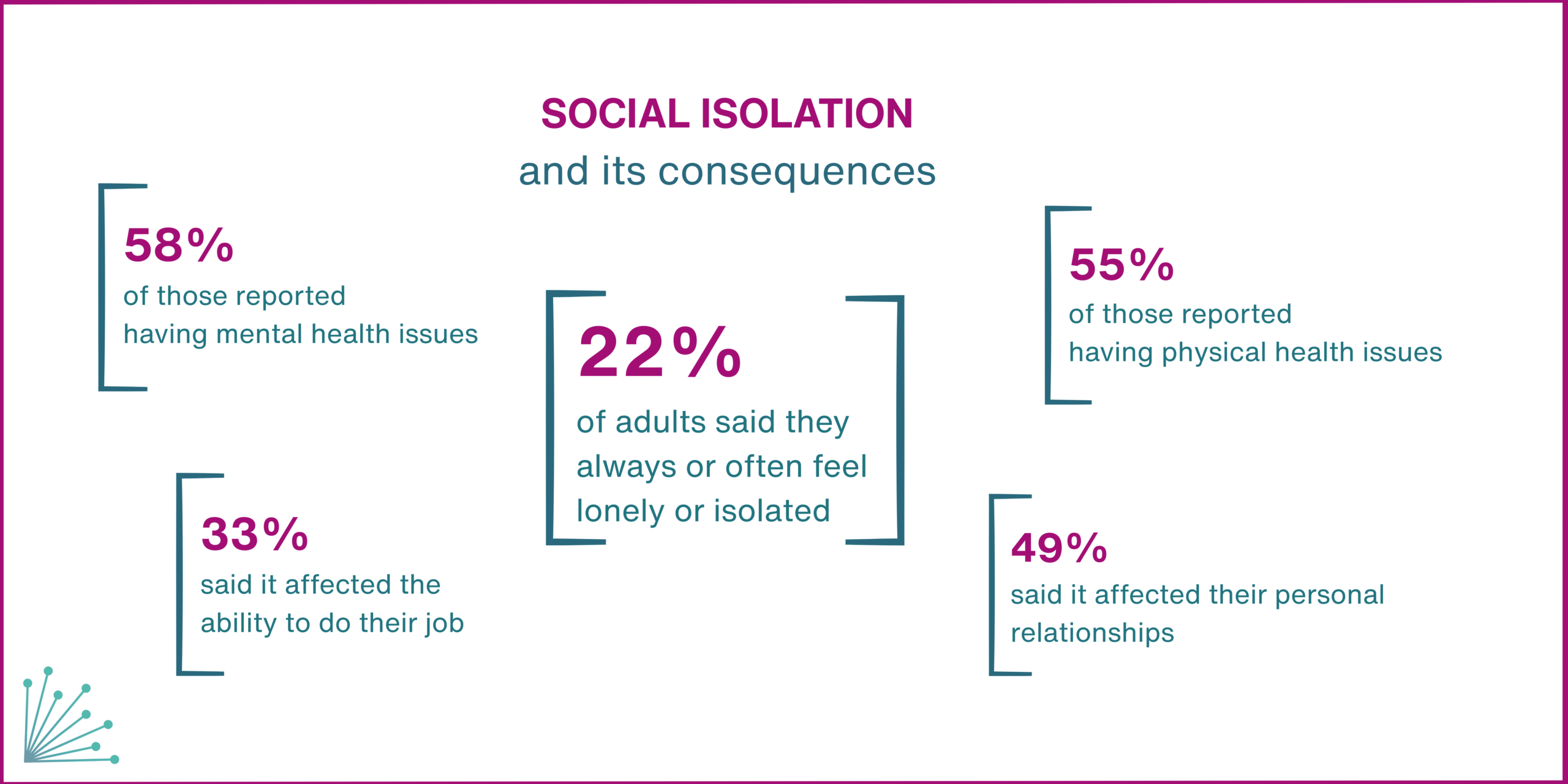
In 2023, the U.S. Surgeon General labelled loneliness a public-health crisis; comparable in health risk to smoking 15 cigarettes a day, and reporting US$154 billion lost annually in the U.S. from loneliness-driven absenteeism alone.
Here’s what the data says happens when loneliness becomes the norm at work (Bryan et al., 2023):
- Performance Declines:
Lonely employees show lower task performance, reduced engagement, and diminished approachability, as reported by both managers and peers. - Wellbeing Suffers:
Loneliness spikes stress, anxiety, and depression. Gallup found fully remote employees experience significantly higher levels of sadness, anger, and loneliness compared to their onsite or hybrid peers. - Cognitive Impairments:
Chronic loneliness hampers executive functioning and focus, increases error rates, and negatively impacts sleep quality, dragging down daily productivity and creativity. - Retention Drops:
Employees facing persistent loneliness become disengaged, show higher absenteeism, and are more likely to leave for roles offering better social connection and inclusion. As discussed in our previous article “The Pillars of Employee Commitment”, this drop in retention can be explained due to a drop in what is known as Affective Commitment, a form of emotional attachment an employee has to the organisation.
Turning Theory into Action: A Leader’s Practical Guide
Loneliness at work isn’t solved by just Pizza Fridays. Here are actionable strategies, grounded in solid research, you can start using right away:
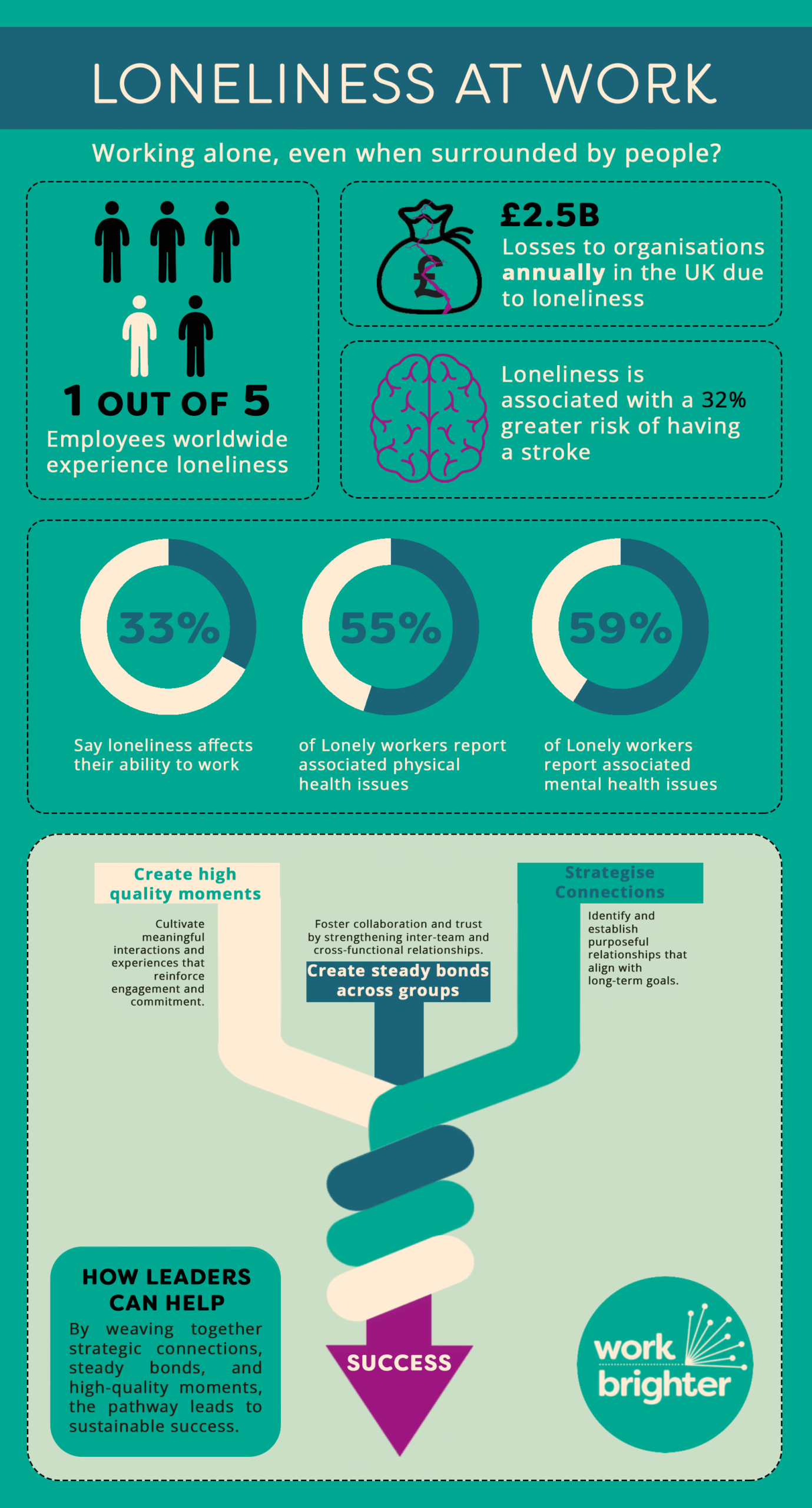
1) Aim at the right bonds
You need depth and breadth (Weiss, 1973):
- Depth (emotional): give people at least one steady, trusted tie (mentor/buddy/manager) who actually checks in.
- Breadth (social): help them opportunity to plug into wider circles (communities of practice, cross-team circles, informal hangouts).
Manager-focused reviews consistently land on the same levers: create opportunities for relationship-building, support people through evolving work contexts (onboarding, hybrid norms), and build a people-first culture. A good manager relationship has constantly shown to reduce loneliness and improve retention.
2) Make high-quality moments common
Loneliness drops when everyday interactions feel respectful, helpful, and trusting, also known as high-quality connections. These are small habits such as real listening, timely help, a bit of playfulness. They’re short, repeatable, and contagious. (Stephens, Heaphy, & Dutton, 2012).
Build tiny windows for these moments (pre-/post-meeting check-ins, co-working bursts). You’re engineering the conditions for connection, not scripting the conversation.
3) Treat connection as strategy (not garnish)
Make belonging a line item, not a vibe.
- Set a light pulse on belonging/loneliness.
- Share what you learned.
- Close the loop with 1–2 visible tweaks each quarter (rituals, manager habits, anchor days).
This mirrors the U.S. Surgeon General guidance: train leaders, design and measure connection, and make it a strategic priority. (Office of the U.S. Surgeon General, 2023).
Leaders who move beyond theory and put these ideas into daily practice don’t just manage loneliness, they transform connection into an organisational strength. When teams see and feel their colleagues regularly, even across screens, real collaboration and sustained performance follow.
Real-World Example:
Airbnb’s “Duos” Approach to Combating Workplace Loneliness
In response to the rising epidemic of workplace loneliness, particularly among early-career employees, Airbnb CEO Brian Chesky implemented a simple yet effective solution: pairing employees into “duos.”
What Did Airbnb Do?
- Duo Pairing: Airbnb began strategically pairing employees, especially in creative and collaborative roles, to encourage deeper professional bonds.
- Cross-functional Connections: Beyond role-based pairs, the goal was to ensure every staff member had at least one close workplace ally, leveraging diverse working and communication styles.
- Leadership Modeling: Chesky “often pairs people” and actively promotes the benefits of partnerships, based on real experiences within creative and business teams.
Why does this matter so much? Social science tells us it’s powerful. A Wharton study shows having a single close friend at work dramatically cuts loneliness. And the numbers back it: Glassdoor recently reported that 6 in 10 Americans under five years into their careers feel lonely on the job—making solutions like Airbnb’s more critical than ever.
The result at Airbnb? Employees paired in duos report feeling more supported, more connected, and more willing to collaborate. It’s a simple fix that drives big impact, or wellbeing, productivity, and company culture alike.
“What really hit home for me was the idea that I don’t always need to have a deep connection with everybody on my team. I need one person who I know has my back…”
Third Spaces (beyond home and HQ)
Third places are neutral, low-stakes venues such as cafés, libraries, and clubs, where people show up for conversation and light social interaction. The idea comes from sociologist Ray Oldenburg, who argued these spaces are essential to community life. (Oldenburg & Christensen, 2023)
Why it matters for loneliness: people build weak-tie bridges in third places, and those bridges feed belonging. A national U.S. survey found that when residents perceive easy access to third places, they also report higher quality of life a proxy for social connection. (Jeffres et al., 2009)
How to use third spaces:
- Offer options, not mandates. Provide a modest stipend or pass for vetted third places (coworking, libraries with meeting rooms, community cafés). It is about the freedom to go to these places, and not about mandating visits for “fun”.
- Create small “gravity moments.” Host office hours, networking parties, or showcase afternoons in third places near employee clusters. Think light touch and regular cadence. (Hadley, Marks & Wright, 2023)
- Let the office borrow from third places. Design a few zones that feel like social clubs with comfortable seating and open nooks, giving your employees some reasons to linger. The office can act like a third place too.
Conclusion
“Lonely” by Akon has more than 1.2 Billion views on YouTube. Maybe it’s just a perfect hook. Or maybe it’s a massive tell: loneliness is more common than we would like to admit. The good news is we don’t have to eradicate it to win. We have to make connecting with each other easier than withdrawal. It’s time to re-design our work place for bonds, social networks, meaningful fit, and, where possible, the simple human nearness that screens simply cannot supply. Do that, and the metrics that matter, employee satisfaction, speed, and productivity, will follow.
References
Bryan, B. T., Andrews, G., Thompson, K. N., Qualter, P., Matthews, T., & Arseneault, L. (2023). Loneliness in the workplace: a mixed-method systematic review and meta-analysis. Occupational Medicine, 73(9), 557–567. DOI org
Hadley, C. N., Marks, B., & Wright, S. L. (2023, February 9). Research: How Coworking Spaces Impact Employee Well-Being. Harvard Business Review. HBR.org
Jeffres, L. W., Bracken, C. C., Jian, G., & Casey, M. F. (2009). The impact of third places on community quality of life. Applied Research in Quality of Life, 4(4), 333–345. DOI.org
Office of U.S. Surgeon General (2023). Our Epidemic of Loneliness and Isolation. HHS.gov
Oldenburg, R., & Christensen, K. (2023, March 22). Ray Oldenburg & Karen Christensen: third places, true citizen spaces. The UNESCO Courier. Retrieved August 7, 2025, from UNESCO.org
Stephens, J. P., Heaphy, E., & Dutton, J. E. (2012). High-quality connections. In K. S. Cameron & G. M. Spreitzer (Eds.), The Oxford handbook of positive organizational scholarship (pp. 385–399). Oxford University Press.
Weiss, R. S. (1973). Loneliness: The experience of emotional and social isolation. The MIT Press.