


Change can happen for many different reasons in an organisation, from developmental changes to improve workflows and processes, to transitional changes like mergers and acquisitions. Change Management Models (CMMs) were developed to help organisations implement change smoothly, however, these change systems can have major limitations because they assume that people are inherently resistant to change and/or that the change is happening within a stable environment with a clear beginning, middle, and end.
But, as you’ve undoubtedly experienced, change is rarely linear and we live in a world of constant creation and innovation – just think of the technological advancements over the past 20 years. Seeing the need for a CMM that works in an unstable world, Rebecca Stevens and the Co-Creation Group developed a new strengths-based change system – the FHOCAL™ model.
A human-centric approach to change
Rooted in positive psychology and the assumption that we’re not automatically resistant but want to be our best, FHOCAL™ creates a change-positive mindset by focusing on strengths and opportunities to generate positive emotions. Harnessing our human traits and helping people focus on strengths works far better than expecting people to act like robots without thoughts about and emotional reactions to what is happening around them.
FHOCAL™ was also designed to be accessible and to work at all levels: individual, team, and organisation. The model’s principles not only help individuals navigate change in their personal life, but helps leaders create more engaged teams and high-performing workplaces.
How to create a change-positive mindset with FHOCAL™
Focus on purpose and meaning:
Have an idea of where you’re trying to go overall, what you really want from life and work. Once you have this in mind it’s easier to work out what you do and don’t need to focus your efforts on.
Be human centric when you act:
Understand you’re not a robot or computer, but a human. You’re infallible, you make mistakes and you have emotions. Learn to work with these things, rather than expecting yourself to work like a robot.
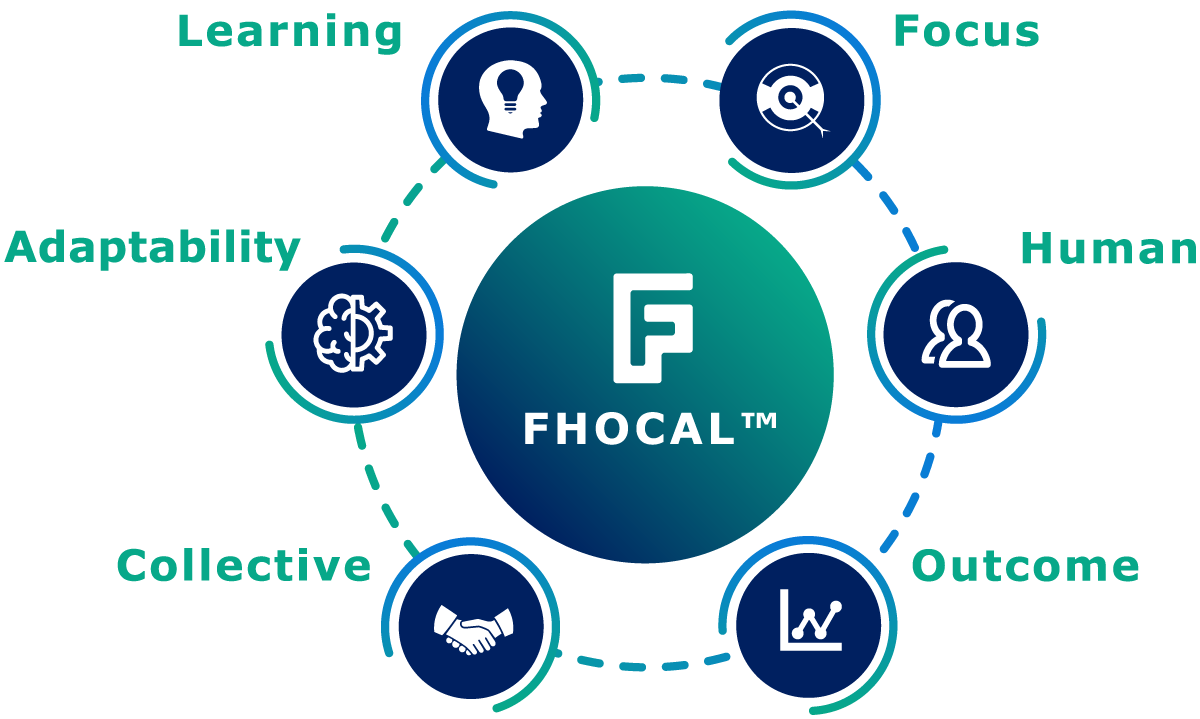
What does what you want tangibly look like? What do you want to see or hear if you’ve been good at doing that? Understand what ‘good’ looks like so you know when you’ve got there or what you need to do to get there.
Work collectively and inclusively:
We are social creatures – we like people and working with them. We work well when we collaborate with each other. How can you do that in a good way that helps you and them, and what does that look like? We’re not human beings on our own, we’re literally with other beings.
Build adaptability and resilience:
What you put together needs to have some flexibility to it. Things are constantly changing so you need to build something that adapts. Work in principles, not rules, to allow for adaptations.
Emphasise learning and growth mindset:
We all make mistakes and that’s part of learning and who we are. It’s okay, and we shouldn’t beat ourselves up, lose confidence or let people tell us it’s wrong. We’re good at learning from these things.
Glueing Teams Together
Rebecca talks about how using the model has a huge impact on peoples’ inner peace and wellness. Becoming the stable piece in an ever-changing world is both empowering and reassuring. It’s about ‘being the buoy in the sea. The sea constantly changes around the buoy, but the buoy is always there. It bobs up and down and moves with the sea, but it’s there and it’s stable.’
In the workplace, FHOCAL™ glues teams together, which is particularly helpful in the world of remote and flexible working. It connects members of the team, making them feel supported by and be supportive of each other, rather than feeling alone. ‘You have a row of buoys at sea, all connected. You’re not in isolation.’ Having this culture within your teams makes the organisation resilient to change and able to adapt and innovate – far better than being on the backfoot.

About Co-Creation Group
Rebecca sits on the strategy team in the Co-Creation Group, working alongside other coaches and consultants to create innovative bespoke solutions based on positive psychology and a strengths mindset, as well as offering leadership coaching.
Working in Occupational Psychology since 2001 means that Rebecca has worked in a broad range of sectors, giving her insight into common business and staff engagement problems and, crucially, what ‘good’ does and does not look like.
As an independent psychologist, Rebecca works with and adapts to the context of your business – what your staff are like and what your engagement and performance challenges are. She isn’t tied into trying to sell a particular psychometric but uses a wealth of resources and tools, bespoke to your needs.
Rebecca is an Occupational Psychologist registered with the Health Care Professions Council, a Chartered Psychologist registered with the British Psychological Society and a registered coach with the International Coaching Federation (ACC).
Get in touch
If you would like to know more about FHOCAL™ and how it can help you build a change-positive mindset in your leaders and teams, please contact Rebecca Stevens at rebecca@workbrighter.co.uk or Co-Creation Group at info@co-creation.group.